As companies move from experimenting with AI to building it into daily operations, the real test becomes deciding what to automate and who should be building it.
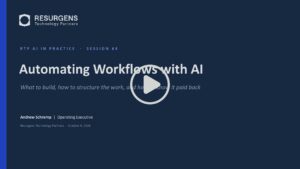
In this session, Andrew Schremp, Operating Executive at RTP, walked through the framework and team structure RTP’s portfolio companies use to prioritize, build, and scale AI-enabled workflows.
Key Takeaways
1. Few companies can point to AI on the P&L, and the gap is rarely the technology.
95% of gen AI pilots show no measurable P&L impact, and the share of companies abandoning most AI initiatives jumped from 17% to 42% in a year. Only 6% are “AI high performers” capturing more than 5% of EBIT from AI. The gap usually comes down to three things: picking workflows by enthusiasm instead of value, building in silos with nobody maintaining the result, and never measuring whether the hours “saved” actually hit the P&L.
2. Build an inventory of the work before you touch a tool.
The process: mine job descriptions for recurring tasks, run short discovery interviews with the people doing the work, profile each candidate workflow on frequency and complexity, and roll it all into one ranked register, typically 50-150 candidates per company. From there, score each one on value against ease of build, and don’t be afraid to deprioritize the ones that don’t clear the bar.
3. A centralized hub beats letting every team build on its own.
Companies with a highly centralized AI team get roughly 75% of their builds into production, compared to about 30% for a fully decentralized approach. The structure: a Center of Excellence that owns the workflow register and governance, a hub of one lead plus two to three dedicated builders, and a spoke in each function who drives adoption.
4. Four plays are already running across our portfolio.
An automated deal desk that checks discount requests against policy and routes exceptions automatically. A rep call prep tool that assembles a one-page account brief from six different systems before every call. A customer risk score built from explainable signals like activity and utilization. And expansion triggers that flag over-capacity accounts for upsell, one portco found $1.86M in ARR tied to usage its customers were already paying to exceed.
5. The payoff shows up as margin, and margin is the competitive weapon.
Portfolio data shows sales, marketing, and R&D spend falling as a share of revenue at AI-forward companies, with ARR per employee climbing well past historical SaaS benchmarks. On a $30M ARR business, even 5 points of lower OpEx is worth $1.5M a year, which is more than $4.5M reinvested in go-to-market over a three-year hold.
Quote
“If you’ve got a highly centralized team focused on AI, you’re getting a lot more production and a lot more value out of it. We’re seeing roughly 75% utilization in centralized organizations, versus 30% in decentralized ones.”
— Andrew Schremp, Operating Executive
To watch our previous episodes, click below.
Episode #1 – Our AI Operating Framework
Episode #2 – Security, Governance, and Risk Management
Episode #3 – AI Spend Visibility & ROI Tracking