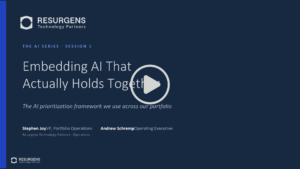
AI in Practice is a series on how to embed AI into your company in a way that actually holds together. The challenge for most companies isn’t ambition, most already want to move on AI. It’s that they end up adding it function by function without a clear sense of how the pieces connect.
This first session covers the bigger picture. Stephen Joy, VP of Portfolio Operations, and Andrew Schremp, Operating Executive, at Resurgens walk through the framework used across our portfolio:
- Security, governance, and risk management
- Automating business workflows (including GTM)
- Transforming R&D and the SDLC
Key Takeaways
1. AI chaos – without rules and collaboration you can’t achieve ROI and scale.
Most companies are adding AI in every function with no sense of how it connects. The result: overlapping tools, no governance, nothing compounds or scales. The fix isn’t more AI. It’s coordination and discipline about how it fits together.
2. Your employees are already using AI whether you’ve approved it or not.
They’re using personal accounts, not your enterprise account. Personal accounts have zero data retention controls, meaning your proprietary data could be going places you can’t track or retrieve. Assume it’s already out in the wild and put shadow AI tracking tools in place.
3. Governance done right is an accelerant, not a brake.
The companies in our portfolio doing the most rework right now are the ones that skipped the governance foundation and jumped straight to building. Governance is the floor, not the ceiling. You build it as a foundational layer so you can move faster, not slower.
4. Giving everyone a license and saying “go build” only gets you so far.
A decentralized approach produces rudimentary gains at best. The companies getting real operating leverage are using a hub-and-spoke model: SMEs in each function surface high-value automation ideas, and a centralized engineering resource actually builds and maintains them. Treat internal automation like product management: discover, prioritize, build, maintain, that’s scalable.
5. There are no shortcuts, discipline and sequencing are critical.
Across ~20 portfolio companies and ~115 operators at our AI Ops Transformation Summit, the biggest unlock wasn’t a better AI tool. It was the sequencing of steps: governance first, then the mapping of workflow automations, then R&D/SDLC. You don’t need a massive AI budget. You need the right people, a clear process, and the discipline to sequence it. That is how you achieve scale and tangible ROI.
Quotes
“Everybody wants to do AI, but they don’t do it in a practical, disciplined way. They’re just after the shiny new objects. It’s typically siloed, departments doing their own things, building their own things. You may get a little bit of short-term gain, but in terms of actually building something that is scalable, repeatable, and process-oriented, that’s not how you do it.”
— Andrew Schremp, Operating Executive
“Setting somebody who’s accountable for this internally is the key to making any kind of progress. From there, putting together the process and education plan is the fastest path to building a culture of governance mindset, and then putting the tools in place to build the guardrails and the monitoring around what’s actually happening in your ecosystem. That’s the order of operations most of the companies in our portfolio are taking.”
— Stephen Joy, VP of Portfolio Operations